

The DLLEVATE
clinical trial is
enrolling!
Exploring new medicines to help treat patients with relapsed small cell lung cancer.
About the study
About DLLEVATE
What is the DLLEVATE clinical trial?
The DLLEVATE clinical trial is a research study for people diagnosed with extensive-stage small cell lung cancer (ES-SCLC) whose cancer has continued to grow during or after treatment with platinum-based chemotherapy, or after tarlatamab as second-line therapy.
The study tests a new investigational medicine called zocilurtatug pelitecan (also known as ZL-1310) to find out whether it is safe and effective for treating ES-SCLC. Zocilurtatug pelitecan is a type of medicine called an antibody-drug conjugate (ADC), designed to target cells that carry a protein called DLL3, which is found on the surface of most small cell lung cancer cells. The safety and efficacy of zocilurtatug pelitecan are being evaluated in the DLLEVATE clinical trial.
DLLEVATE compares zocilurtatug pelitecan against currently available treatments, including topotecan or amrubicin, to evaluate whether zocilurtatug pelitecan offers a better option for patients at this stage of their disease.
About the Disease
Extensive-stage small cell lung cancer (ES-SCLC) is a fast-growing and aggressive form of lung cancer.
Lung cancer is generally divided into two main types: non-small cell and small cell. Small cell lung cancer is much less common, making up about 15% of all lung cancer cases, but it grows and spreads faster than other types—which is why early action matters.
The term “extensive-stage” means that by the time the cancer was found, it had already spread beyond one lung and nearby lymph nodes. It may have moved to the other lung, the fluid around the lungs, or to distant organs such as the liver, bones, or brain.
Small cell lung cancer is most commonly diagnosed in older adults and is often associated with a history of smoking, though not always. Because ES-SCLC grows so quickly, symptoms can appear suddenly and may include shortness of breath, chest pain, swelling in the face or neck, fatigue, and loss of appetite.
Standard treatments like chemotherapy, checkpoint inhibitors, a type of immune therapy, and tarlatamab, another type of immune therapy, are available, depending on country and region. Clinical trials can help us try to discover better ways to treat diseases.
Trial Information
For Healthcare Professionals
Clinical Overview
Zocilurtatug pelitecan is a novel DLL3-targeting antibody-drug conjugate (ADC) in development for the treatment of small cell lung cancer (SCLC) and other DLL3-expressing tumors.
DLLEVATE is a global Phase 3 randomized controlled trial evaluating the efficacy and safety of zocilurtatug pelitecan compared to investigator’s choice of single-agent chemotherapy (topotecan or amrubicin) in patients with relapsed ES-SCLC who have progressed on or after platinum-based first-line therapy or after tarlatamab as second-line therapy.

Inclusion and Exclusion Criteria:
Key Inclusion Criteria
- Age 18 years or older at the time of consent or considered an adult by local regulations
- Histologically or cytologically confirmed ES-SCLC with documented disease progression during or after platinum-based first-line systemic therapy, with or without checkpoint inhibitors; prior second-line therapy is permitted if the therapy is tarlatamab; patients receiving tarlatamab as part of their first line therapy may still be eligible
- Measurable disease per RECIST v1.1 as assessed by the investigator
- Treated and stable, or untreated and asymptomatic CNS metastases, as defined per protocol
- Adequate organ and marrow function
- ECOG performance status of 0 or 1
- Must be a candidate for at least one of the investigator’s choice of single-agent therapy (topotecan or amrubicin) with no prior exposure to the selected agent
- Willingness to undergo tumor biopsy or provide archived tumor tissue at screening
Key Exclusion Criteria
- More than one line of systemic chemotherapy for ES-SCLC
- Prior treatment with any ADC containing a topoisomerase 1 inhibitor payload
- Known concurrent malignancy, with exceptions as defined in the protocol
- History of non-infectious interstitial lung disease (ILD) or pneumonitis requiring corticosteroids, current ILD/pneumonitis of any grade, or suspected ILD/pneumonitis that cannot be ruled out by imaging at screening
- Clinically severe pulmonary compromise, including resting oxygen saturation (SaO2) below 90% and/or requirement for continuous supplemental oxygen
- Receipt of systemic (injection) anti-cancer treatment within 3 weeks prior to the first dose of study treatment
- Radiotherapy within 2 weeks prior to first dose for non-thoracic areas, or within 4 weeks for thoracic areas; prior thoracic radiotherapy of 30 Gy or more in total dose
Study Design
Eligible participants will be randomized 1:1 to receive either zocilurtatug pelitecan at 1.6 mg/kg administered intravenously every three weeks, or investigator’s choice of single-agent chemotherapy (topotecan or amrubicin), until approximately 480 participants have been enrolled across both treatment arms.
Tumor imaging will be performed every six weeks and evaluated per RECIST v1.1 criteria by a blinded independent central review committee (BICR).
Primary Endpoints
- Overall survival (OS)
- Overall response rate (ORR) per BICR
An interim analysis of BICR-assessed ORR is planned following randomization of approximately 200 participants across both arms, with adequate follow-up time for response assessment.
Frequently Asked Questions
Yes. Patients who received tarlatamab in either first-line or second-line setting are eligible. Second-line systemic therapy is permitted only if it consisted of tarlatamab—no other second-line agents are allowed.
Yes, patients with LS-SCLC may be eligible if they experienced disease progression within 6 months of completing platinum-based chemotherapy and had not received other chemotherapy, or had disease progression after 6 months of completing platinum-based chemotherapy and had received 1 line of platinum-based chemotherapy in the setting of ES-SCLC (with or without tarlatamab).
Yes. Patients with a history CNS metastases are eligible if they have either treated and stable, or untreated and asymptomatic, brain metastases meeting the following criteria:
For treated and stable CNS metastases — all of the following must be met:
- Only brain parenchymal metastases are permitted; leptomeningeal metastases are excluded
- CNS-directed therapy (surgery and/or radiation therapy) must be completed at least 2 weeks prior to randomization
- Patients must be on stable doses or off corticosteroids (doses ≤10 mg daily of prednisone or equivalent) and/or anti-convulsants for at least 7 days prior to randomization
Untreated and asymptomatic CNS metastases:
- Patients must not require corticosteroids, anti-convulsants, or local CNS-directed therapy as determined by the investigator per local guidelines with untreated and asymptomatic CNS metastases must not require steroids and/or anti-convulsants, nor local therapy as determined by the investigator per local guidelines
No. The protocol does not include pre-planned cross-over to provide zocilurtatug pelitecan as the treatment after chemotherapy in the control arm. However, the treatment of participants after they progress from the study drugs, either in the zocilurtatug pelitecan arm or in the control arm, will be determined by the treating physicians. There are no restrictions in the protocol about the post-progression treatment.
Trial Information
For Patients
About the Study
Zocilurtatug pelitecan is an investigational medicine being studied as a potential treatment for small cell lung cancer. Zocilurtatug pelitecan is a type of medicine called an antibody-drug conjugate (ADC) designed to target cells that carry a protein called DLL3, which is found on the surface of most small cell lung cancer cells.
In the DLLEVATE study, zocilurtatug pelitecan is being compared to standard chemotherapy options that your doctor may choose from, including topotecan or amrubicin.
Risks and Benefits
The DLLEVATE study is evaluating whether zocilurtatug pelitecan may provide clinical benefit compared to currently available treatments. Participation involves potential risks and uncertain outcomes, which your study doctor will discuss with you in detail.
Taking part in any clinical trial involves some risk. As with any medical treatment, there is no guarantee that zocilurtatug pelitecan will improve your condition, and your disease may continue to progress during the study.
Like all medicines, zocilurtatug pelitecan may cause side effects. These can range from mild and temporary to more serious. Some side effects may go away on their own or can be managed with additional treatment. Others may last longer, become permanent, or in rare cases may be life-threatening.
Based on available clinical data, the most common side effects (may affect more than 1 in 10 people) include inflammation of the lungs, decrease in white and red blood cells, decrease in platelets, and nausea. It is important to talk openly with your study doctor about any symptoms you experience during the study. Your health and safety are the top priority of the study team, and you will be monitored closely throughout your participation.
If you have questions about the specific risks and side effects associated with zocilurtatug pelitecan, please speak with your doctor or a member of the study team. For additional information and to explore participation, please visit ClinicalTrials.gov to find a participating clinical trial center near you. Please contact the center directly for details about the study and support available to participants.

Who can take part in the DLLEVATE clinical trial?
You may be able to participate in the DLLEVATE trial if:

You are age 18 years or older.

You have been diagnosed with small cell lung cancer.

Blood tests show that your major organs—including your liver, kidneys, and bone marrow—are functioning well enough to safely participate in the study.

You received standard treatment, and your cancer has continued to grow despite that treatment.
This list does not include all the trial participation criteria and details. For additional information and to explore participation, please visit ClinicalTrials.gov to find a participating clinical trial center near you. Please contact the center directly for details about the study and support available to participants.
Safety Information
Before you Begin
Before you receive any study treatment, your study doctor and study team will conduct a thorough review of your medical history and perform a series of tests to make sure it is safe for you to participate. You will have the opportunity to ask questions and discuss any concerns before making your decision.
During Treatment
Throughout your time in the study, your study team will monitor you closely. This includes:
- Regular visits with your study doctor to assess how you are feeling and how your body is responding to treatment
- Routine blood tests and imaging scans to track your health and monitor for any changes
- Ongoing review of any side effects or symptoms you may experience
- Prompt medical attention and support if any health concerns arise
You are encouraged to contact the study at any time, including between visits, if you experience any new or worsening symptoms, have questions, or simply need support. Your study team will provide you with contact information so help is always within reach.
After Treatment
Your study team’s commitment to your health does not end when treatment does. After you finish study treatment you will continue to be monitored through a series of follow-up visits and check-ins to make sure you are doing well and to track any longer-term effects.
Reporting Side Effects
All side effects, whether or not they are thought to be related to the study treatment, will be carefully recorded and reported. This information is an important part of understanding the safety of zocilurtatug pelitecan and improving care for future patients.
Your Rights as a Participant
- You may withdraw from the study at any time, for any reason, without penalty or impact on your medical care
- Your personal health information will be kept strictly confidential in accordance with applicable privacy laws
- Participation in this study is entirely voluntary
Frequently Asked Questions
A clinical trial is a research study that explores whether a new medicine or treatment is safe and effective for people with a specific medical condition. The Food and Drug Administration (FDA) require clinical trials be conducted before a drug or device is approved and made available to patients.
- Every clinical trial has a specific set of criteria that determines who is eligible to participate. For the DLLEVATE study, you may qualify if:
- You have been diagnosed with extensive-stage small cell lung cancer (ES-SCLC)
- Your first treatment included platinum-based chemotherapy, but your cancer has continued to grow or has come back since completing that treatment
- You may also be eligible if you received tarlatamab as part of the first treatment or a second treatment and your cancer has continued to grow since then
- Your liver, kidneys, and blood counts are within acceptable ranges as determined by your study doctor
- You are able to carry out basic daily activities
- Only a study doctor can confirm whether you qualify. If you are interested in finding out, the best first step is to talk to your current doctor and ask whether DLLEVATE may be right for you. For additional information and to explore participation, please visit ClinicalTrials.gov to find a participating clinical trial center near you. Please contact the center directly for details about the study and support available to participants.
- Informed consent is the process your study doctor uses to make sure you fully understand what participating in the DLLEVATE study involves before you make any decisions. You will be given an informed consent form — a document that explains the study in detail, including what to expect, what your rights are as a participant, and any potential risks and benefits.
- There is no rush. You are encouraged to take the form home, read it carefully, and discuss it with your family or friends before deciding. Your study doctor and study team will be available to answer any questions you may have — before, during, and after this process.
- It is important to know that signing the informed consent form does not lock you in. You may withdraw from the study at any time, for any reason, without penalty or any impact on your regular medical care.
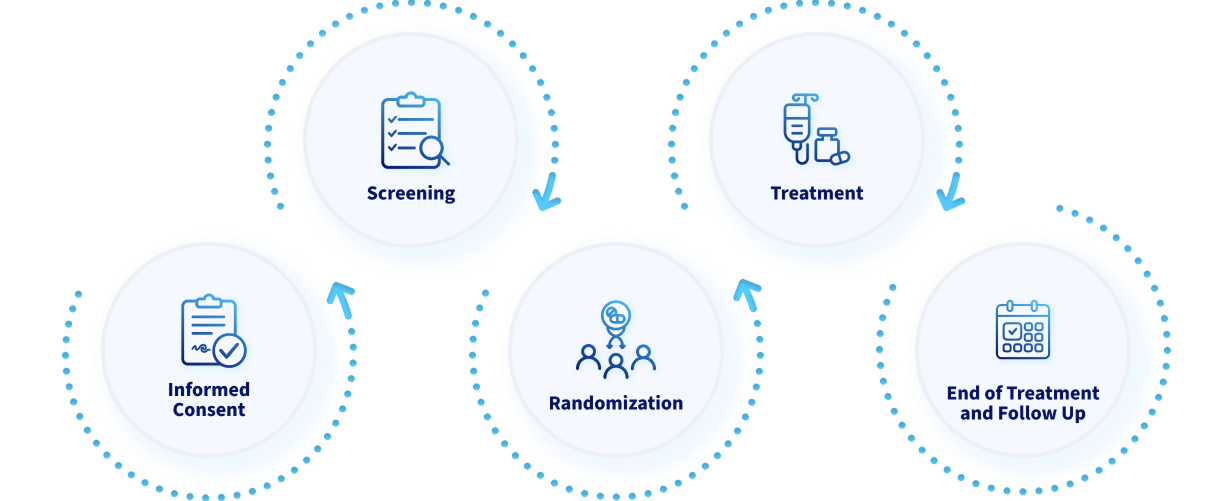
If you decide to join the DLLEVATE study, here is what you can expect:
- Screening — Before you receive any study treatment, your study doctor will conduct a series of medical tests, such as blood tests and imaging scans, to confirm that it is safe for you to participate.
- Randomization — If you qualify, you will be assigned to one of two treatment groups by a process called randomization — similar to a coin flip. You will have an equal chance of receiving either zocilurtatug pelitecan or your doctor’s choice of standard chemotherapy. This process ensures the study results are fair and unbiased.
- Treatment — Whichever treatment group you are assigned to, you will receive treatment once every three weeks for as long as your doctor determines you are benefiting from it.
- Monitoring — Throughout the study, your study team will monitor your health closely through regular visits, blood tests, and imaging scans. You are encouraged to contact your study team at any time between visits if you have questions or concerns.
- Follow-up — After you finish treatment, your study team will continue to check in with you — with visits at 7 days and 30 days after your last dose, and then every 12 weeks to monitor your overall health and well-being.
Yes — participation in the DLLEVATE study is always voluntary. You may choose to withdraw at any time, for any reason, without penalty and without any impact on your regular medical care. Your study doctor will continue to support you and discuss other available treatment options with you if you decide to leave the study.
If you have any concerns or questions about your participation at any point, we encourage you to speak openly with your study doctor and study team — they are there to support you every step of the way.
To determine any costs associated with receiving treatment as part of a clinical trial, patients should consult with their physician, study coordinators, and health insurance providers.
Helpful Materials
Resources
DLLEVATE Flyer
Information about the DLLEVATE clinical trial to discuss with your healthcare provider.
 Download
Helpful Materials
Resources
Patient advocacy groups can offer additional educational resources.
The following links have been compiled to help patients with small cell lung cancer and their caregivers find additional information, support, and community. The descriptions provided reflect information supplied by the organizations themselves. Zai Lab has not verified this information and does not endorse, nor accept responsibility for, the content, information, or services provided through these external links.
Please note that this is not a comprehensive list. Many additional resources and support organizations exist for patients, caregivers, and families, and we encourage you to explore what may be most helpful for your individual needs.
- American Lung Association The American Lung Association was founded 120 years ago and is a trusted source for lung health education, lung disease research, support, programs, services, and advocacy.
- CancerCare CancerCare provides free, professional support services and information to help people manage the emotional, practical, and financial challenges of cancer.
- GO2 For Lung Cancer GO2 for Lung Cancer provides one-on-one assistance, supportive connections, treatment information, and help finding care close to home.
- LiveLung LiveLung brings together cancer patients, survivors, and their caregivers together for empowerment through education and community.
- LUNGevity LUNGevity is focused on transforming how people are diagnosed and live with lung cancer through research, education, and support.
- Lung Cancer Foundation of America The Lung Cancer Foundation of America is working to change the public perception of lung cancer through education and personal stories about lung cancer and to improve patient outcomes through funding impactful research.
- Lung Cancer Research Foundation The Lung Cancer Research Foundation is focused on funding innovative, high-reward research with the potential to extend survival and improve quality of life for people with lung cancer.
Get In Touch
Contact Us
If you have questions about clinical trial locations or participation, please enter your email address here and a member of the Zai Lab team will contact you. Responses may take up to 72 hours.

* Required

Zai Lab
Sponsor of the DLLEVATE clinical trial